Albany-Buffalo-Albany: A ride on the Erie Canal Trail

kizarmynot

Well-Known Member
I just completed a two week tour of the Erie Canal Trail (750 miles total) on my Q45 and want to share my bike setup as well as a few other things that may be helpful to others. Because this could be a long post I've broken it into several parts: Bike Setup, Gear Load, General Riding and Bike Skills, and What Worked and Needs Improvement. I'll start with the bike setup in this post.

Bike Setup

This is a picture taken during my shakedown ride. A few things changed along the way so I'll make note of those. I'll also only point out things that are not standard.
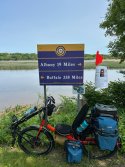
bike.jpeg

Starting from the ground and working up, I had a pair of wheels built by Peter White. These are Cliffhanger 559 (26”) 36-hole rims and White Industry XMR hubs. I have had good luck with Surly ExtraTerrestrial tires in the past, so I opted for the 26x46 running tubeless. Front and rear tires surrounded by Planet Bike fenders.

The drivetrain is SRAM GX AXS 12 speed derailleur. I originally installed the GX mechanical groupset and it worked great. I was surprised at the ease of shifting for a mechanical shifter, but I have always been concerned with the arthritis creeping in so converted to electronic. Overall very happy except with battery monitoring in the app. I purchased a second battery during my mid-way rest stop and will always carry it along.

I also wax my chain using Silca products. Love them and don't see a reason to change.

Pedals are from Pedaling Innovations. The larger platform gives me more options to place my foot. Up to this point my arch has been a little forward of the spindle and this was not much of a problem during previous rides. However, riding 6 hours per day for many days in a row I started developing foot discomfort that went away when repositioning my foot or getting off the bike. More on this topic in a later post.

I started off with my main water bottle mounted on the boom. This is another thing that worked well for short rides but the repeated use when removing and replacing the water bottle resulted in the bottle holder slipping around. I removed it a few days in because of my improved ability to access a water bottle behind the seat. More on that later too.

A Ventisit pad replaced the standard seat pad. As you can see it is fairly upright. I had tried reclining the seat a bit but discovered I needed a headrest beyond this point. For rides of a few hours prior to the tour I'd get some minor RB pain but nothing that I would say was too problematic. Unfortunately that wasn't the case for this trip. I'll touch more on this later.

Another great modification (IMO) I made was changing the handlebars to the Jones H-Bar Loop. I used these on two other DF bikes I rode in the past and enjoyed them but have to say I was really surprised at how much I like them on my Q. I used the entire length of the grip depending on how I was riding, and the loop is a great place for the computer, phone mount, light (not shown) and my bell. I can't say enough about the bars.
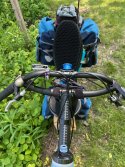
Jones.jpeg

Additional Cruzbike accessories include the rear and underseat racks as well as the short crankset. I also started off with a SteerStopper and ClikStand. I failed to disengage the SteerStopper one too many times and the strap developed problems. I am still a firm believer in the product and ordered a replacement that is now in the queue for post-ride modifications. The ClikStand was awesome, but I lost it at some point - what a bummer. I ordered a new one and hope it arrives before my next tour.

I'll talk about my gear load in the next post.
 
Last edited:
kizarmynot

Well-Known Member
Part 2: Gear Load

I started and ended with 6 different bags for the trip. Packing for a bike trip (I should say any trip) has always been a struggle for me - I frequently pack too much. Even though I slimmed things down since my first trip a few years ago I still found myself reducing even more during my mid-ride rest stop in Buffalo. Here's how things were organized.

Rear Panniers
One for sleeping bag and pad, the other for clothing and toiletries. I used nearly all the clothing I ended with, and the stuff I didn't I would bring again because the weight/volume savings is minimal. Here's what I ended with.
  • 2 under-helmet beanies. For those of us with a lot of scalp, this is a necessity IMO.
  • 2 merino wool shirts – one for on-bike and another for sleep that could be used on-bike too. I love my merino wool products. For the shirts I could go at least 4 days without shirt odor (I was able to take a shower every night). When salt stains got too bad, I rinsed it in a sink at let it dry until the next day.
  • 4 merino wool boxers – on-bike, off-bike, sleep and spare. Number may have been overkill, but a pair of boxers is not going to break the weight or volume bank.
  • 3 merino wool socks - on-bike, off-bike and spare. I wore the on-bike 5 days before washing because I had the opportunity, not because they smelled.
  • 2 “bike” shorts – one on-bike the other off.
  • 2 arm sun sleeves – one as a spare because I don't want to resort to sunscreen on my arms.
  • 1 sun gloves – only own one pair but will buy another before the next tour because they were looking/feeling/smelling well used after a week.
  • 1 polo shirt – wanted a change after the ride was done.
  • 1 wind vest, 1 packable down vest, 1 arm warmers. All used throughout the trip.
  • 1 pair tights – came in handy on chilly mornings on the bike and one chilly night.
  • 1 extra long-sleeve shirt – came in handy on the chilly night.
My rain gear was packed in a separate dry bag that was strapped to the rear rack. This was a change made mid-way.

Front Panniers
One is for cooking (MSR PocketRocket Mini Stove Kit and fuel) some basic utensils and a few other containers for food. This is something that may actually increase in size/weight as I explore camp cooking.
The other is miscellaneous, things like my electronics support (battery pack, cables, miscellaneous devices), first-aid kit, spare inner tube, and ice pack.
The battery pack is something I gave some thought to mid-way. It weighs just over 1 pound and has more storage capacity than I really need. Looking into it a bit more I've determine that I can get a smaller battery, but weight savings is about ½ pound and will cost money that can really be used better for the next trip, so I'm going to hang onto it.

I also have two electronic devices that were not widely available even a year ago: a tire pump and another pump to inflate my sleeping pad. I am sold on the tire pump because it makes monitoring and adding air to my tires so much easier, even though not completely satisfied with the device I purchased. The other pump is nice, but I've determined it is a luxury I can do without (I may consider it again if I was going out for a longer trip and had to blowup my pad every night).

Tent bag
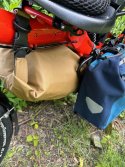
You may have noticed in the original post that I mounted a bag between the front panniers. Here's another picture. I use the bag clip to mount it to the bike, and another strap to keep is secured. This mounting method worked well and removed some weight from the rear rack.
tent.jpeg

I started off with a trunk bag mounted to the top of the rear rack. My initial thought was that this would be used to make access to things like sunscreen, first aid kit, bike locks, etc., easier throughout the trip. After I reduced my load mid-way I realized I could distribute the things in there to the other panniers and access was not that difficult. The trunk bag will be used for day-trips, but no longer for touring.
After removing the trunk bag, I used the available space to to secure my rain kit.

In addition to the six main bags, there are a few others to mention.
  • There is a bottle/feed bag mounted on the bars. The small mesh pockets around it were very convenient for things like lip balm, spare change, used wrappers, and the ClickStand (until it fell out). The main pocket was used for a snack or some other item I wanted to keep easily accessible while riding.
  • My bike tools are mounted in the space between the seatback and the rear wheel. I used an old smallish bike bag that fits perfectly into that space.
  • While not a bag, you can see in the first picture of the post that I have a Hydro Flask mounted to the seatback. My water capacity was: the flask, my primary water bottle mounted on the other side of the seat, and one more water bottle stored elsewhere. I really enjoy having cold water later in the day but wonder if it's worth the weight (just over 1 pound).
For those that are wondering, I am not a weight weenie. I consider myself a member of the Clydesdale community, although riding more this year is making an impact (my retirement plan, yeah!). BUT, when I am trying to get myself up a climb with nearly 50 pounds of gear (let alone a bike that is not light) I think about these things.

So, what did it all weigh. Before the trip my load was 56.4 pounds; this included some food but not water. After my reduction at the mid-way point the load was reduced to 45.8 pounds. Some of this difference may have been the food, but I still think I got rid of at least 8 pounds of gear. In addition to the weight, the volume reduction made packing the bags every day much easier. Is this my final touring load weight? Unless I find a wad of cash and go with ultralight products I'm not sure what more I can do. Besides, I still have “a few” pounds I can lose on my frame so I think I'll focus on that for the time being.

I'll talk about my general riding and bike skills observations in the next post.
 

kizarmynot

Well-Known Member
Part 3: General Riding and Bike Skills

With an active ride time of about 6 hours per day and the majority of that time on off-road trails, there were plenty of opportunities to practice some skills. One of the things I got much better at was starting from a stop. At the beginning of the ride my standard method was putting my left foot on the pedal and then pushing off with my right. I don't remember when it happened, but I started using only my left foot on the pedal for starts. It was shaky at first but after a while it got much better. Even on the occasions when the start wasn't the best my body figured out how to keep balance (even with a load) so that I could gradually get going. I still have times when I need to put a foot down and try again, but I feel much more confident that I can start with a single pedal push.

Back when I was first learning to ride and I tried using the bottle cage behind the seat I almost fell over trying to put it back in. At the time I didn't want to deal with it because I had another mounting spot on the boom so I didn't try it again. When the bottle cage on the boom started having problems I either had to live with it or learn how to access the water bottle behind the seat. Almost without thinking I was able to get the water bottle and put it back. This has now gone to doing this while pedaling.

Overall I am a much better rider than before I started. I will likely never get to no hands (not sure why I need to do it), but the essential skills are all there.
 

kizarmynot

Well-Known Member
Part 4: What Worked and Needs Improvement

What worked? I was happy with the Q45 as a touring bike. At the beginning it was carrying nearly 275 pounds of load (rider+gear+water) and there were no problems. The modi fications I made (wheels, tires, drivetrain, handlebar) all worked flawlessly. I'm looking forward to my next trip in mid-July and hope to address the things that need improvement before then.

So, what do I need to improve or modify? First and foremost is the dreaded recumbutt. During shorter (up to 4 hours) rides before the trip I'd have some discomfort, but I was able to address it by stretching in the seat or getting off the bike for a few minutes. By the last few days of this trip the pain was almost unbearable after about 10-15 minutes. I actually looked forward to street crossings to have an excuse to get off the bike and walk for a minute. I found a neck rest that I will be installing very soon that will enable me to recline the seat. I'm hoping the max angle for the stock seat is enough to address the RB.

I had some foot discomfort, but that was much easier to address by changing my foot position. This week I started shortening the boom length to allow my foot to move forward to get the arch over the spindle (intended position of manufacturer), but find myself needing to check the position frequently to make sure the feet haven't moved forward.

Touring fitness is the other thing I need to keep watching. I can say it is possible to ride yourself into fitness, but it is not easy. It's good that I have a short time between trips, but I also know that fitness can go away quickly especially as I get older.
 

Chunky

New Member
I love this setup. Did the Erie in May. I should have taken more pictures. Did you get cussed out by the guy somewhere around Clyde NY? What an experience that was. He has an alarm when you get near his property. Crazy…anyhow the bike looks great.
 

kizarmynot

Well-Known Member
The guy wasn’t out but I am familiar with the property. I did that section last year and it was clear he didn’t like the current president. This year that name was gone but the general message is still there.
 

JoFlo

Member
I like your setup and have reread it several times to give an idea on how setup my bike. I recently acquired a 2021 Q45 to replace my S30 that was destroyed in an accident (that’s another story for another time). I have four bags I can use, just need to purchase the racks that go below the seats. As for gear, have my backpacking (sleeping bag, pad, tent, stove, cooking gear, etc.) that will work just fine. I do use SPD pedals and prefer being clipped in, but can use the flat side of the pedals also. I have two under the seat water cages and also a waist fanny pack spun around to the front (the belt buckle helps support my lower lumbar), holding 50 oz of water.
l’m curious about which electronic air pump you chose?
You mentioned a kickstand, I know the stock one doesn’t work with lower racks. Did find one that does?
 

Attachments

  • IMG_5385.jpeg
    8.1 MB · Views: 20
Last edited:

kizarmynot

Well-Known Member
two under the seat water cages
The under seat may not work with an under seat rack.

which electronic air pump you chose?
I started off with a Cycplus Tiny Pump. Unfortunately it failed - faulty air pressure indication. I then purchased a Flextail Tiny Bike Pump Pro. At some point I also reached out to Cycplus about the failure and was surprised when they sent me a replacement. So, I now have 2 pumps - I keep the Flextail in my bike tool bag, and the Cycplus at my workbench. There are two things I like about the Flextail: the pressure adjustment buttons are on the side and less likely to be pressed accidentally, and the power button is bigger. Both work well as a bike pump.

You mentioned a kickstand, I know the stock one doesn’t work with lower racks. Did find one that does?
I use a Click-Stand. It’s not as convenient as a kickstand but works well.

One more thing. I made a separate post about the rear rack wobble I discovered.
Thread 'rear rack wobble'
https://forum.cruzbike.com/threads/rear-rack-wobble.16210/
I have not toured with the Q again (used my S40 last trip) so don’t know if adjusting the shock improved it. I’d suggest trying to get as much weight as you can on and between the under seat racks if you experience a lot of wobble.

Enjoy!
 
Top