
I am dreaming of custom MBBs. (only because Cruzbike does not offer every kind of bike  ) I would benefit from front suspension, though and that is tricky on an MBB. When the suspension moves, the bottom bracket should stay in sync with the seat and the chain length should not change.
Flevobike have done it with a trailing swing arm, but that free floating boom that has to bear all the forces might get a bit heavy? Also the movement path of the wheel probably changes trail a lot. (And when adjusting the position of the bottom bracket, you change either the chain length or the trail, depending on if the swing arm moves with the bottom bracket.) Swing arm bearing is not in the middle of the swing arm but next to the chain line. To minimise talk between drive and suspension.
There arew contraptions that work similarly.
And there are crazy over engineered solutions that probably weigh a lot and destroy the beautiful drive train efficiency.
Cruzbike did it with a telescopic fork in the past or it was at least possible to do. Seems like little movement and crosstalk, but I think you can not just go and get a custom telescopic fork and I do not want soma hacked adapter to get a drive on it.
And then I came across four bar linkage forks and the crazy stuff you can do with them!
...and strictly speaking you do not even have to put (all of) it inside the fork...
https://de.pinterest.com/pin/1196337401657902/
Four bar linkages can achieve some wild movements and I am searching for a setup that can achieve a good movement path for the wheel whith minimal movement of the bottom bracket and no change in chain length (Axle and BB on the same bar, I guess, but one idler might be acceptable). Questions will be if pedaling torque will create an additional input to the pushing of the leg on the pedal and the chain pulling between bottom bracket and axle (rather outsite points of chein ring and cog!).
I have found this rudimentary online tool (sorry, it is in German) http://www.tm-aktuell.de/TM5/ViergelenkAnimation/viergelenkanimation.html
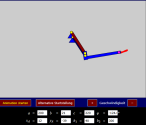
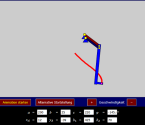
and with just a little bit of fooling around came up with this mechanism (one shows the bottom bracket as the output, one the wheel; dimensions in centimeters for a 20" wheel and somewhat long legs; can not link to a configuration, you need to put in the values manually, if you want to modify them). I am sure with a more usable tool, some training and more work and trying completely different arrangements, great improvements are still to be made!
Does somebody know a good tool (not expensive and easy to learn) or can and want to help? Also sturdyness and weight as well as manufacturability are of course important questions.
(By the way: Who noticed that my weird keyboard does not have a working apostrophy? )
) I would benefit from front suspension, though and that is tricky on an MBB. When the suspension moves, the bottom bracket should stay in sync with the seat and the chain length should not change.Flevobike have done it with a trailing swing arm, but that free floating boom that has to bear all the forces might get a bit heavy? Also the movement path of the wheel probably changes trail a lot. (And when adjusting the position of the bottom bracket, you change either the chain length or the trail, depending on if the swing arm moves with the bottom bracket.) Swing arm bearing is not in the middle of the swing arm but next to the chain line. To minimise talk between drive and suspension.
There arew contraptions that work similarly.
And there are crazy over engineered solutions that probably weigh a lot and destroy the beautiful drive train efficiency.
Cruzbike did it with a telescopic fork in the past or it was at least possible to do. Seems like little movement and crosstalk, but I think you can not just go and get a custom telescopic fork and I do not want soma hacked adapter to get a drive on it.
And then I came across four bar linkage forks and the crazy stuff you can do with them!
...and strictly speaking you do not even have to put (all of) it inside the fork...
https://de.pinterest.com/pin/1196337401657902/
Four bar linkages can achieve some wild movements and I am searching for a setup that can achieve a good movement path for the wheel whith minimal movement of the bottom bracket and no change in chain length (Axle and BB on the same bar, I guess, but one idler might be acceptable). Questions will be if pedaling torque will create an additional input to the pushing of the leg on the pedal and the chain pulling between bottom bracket and axle (rather outsite points of chein ring and cog!).
I have found this rudimentary online tool (sorry, it is in German) http://www.tm-aktuell.de/TM5/ViergelenkAnimation/viergelenkanimation.html
and with just a little bit of fooling around came up with this mechanism (one shows the bottom bracket as the output, one the wheel; dimensions in centimeters for a 20" wheel and somewhat long legs; can not link to a configuration, you need to put in the values manually, if you want to modify them). I am sure with a more usable tool, some training and more work and trying completely different arrangements, great improvements are still to be made!
Does somebody know a good tool (not expensive and easy to learn) or can and want to help? Also sturdyness and weight as well as manufacturability are of course important questions.
(By the way: Who noticed that my weird keyboard does not have a working apostrophy?
)