How well can the s40 handle smaller 2x front chainrings with di2/etap?

lacohe

New Member
I recently picked up a s40 which has been great for me. It has been so long since I've gotten off a bike without pain, and I even remarked to my partner that it's surreal finishing a long ride and not experiencing nerve pain for the next couple hours.

With that said, I have been eyeing some groupset upgrades for the future. While I like the range of the apex 1x, I don't like the big jumps between gears especially around threshold efforts. I've been looking at past posts over the years regarding the front derailleur issue on the v20/s40 not handling compact (or smaller) chainsets well. However, I've read mixed reports where some have said di2 50/34 and axs etap 46/33 work without issue ("fine").

Given the cost and time of purchasing and installing groupsets, I was hoping to get any updated information on how well either work out of the box. Is it as smooth as one would expect for a standard setup, or does it 'get the job done'? Are chain drops still an issue as previously mentioned with their mechanical cousins?
 

Frito Bandito

Zen MBB Master
I ride a V20 with SRAM AXS, and since it is always on the flats I ride with larger (52/36 or a 54/40) chainrings so keep that in mind. I got mine set up right and never had any issues with it on the front or rear. For some reason I couldn't ever really get mechanical groupsets to work well, no matter how many videos I watched or manuals I read so I decided to give AXS a try. Once I put AXS on and went through the app settings to microadjust the rear derailleur during Corona it has pretty much been flawless since then. My derailleur stalk maxed out at the 54t size, but since I am older and prefer a slower cadence I switched the 54t out for a 58t. The front derailleur won't fit so I just keep it on the 58t all the time and can kick it over to the 40t if required. So, I essentially run as a 1x now. With all that said, I don't think you'd have any issues with chain drops using an off-the-shelf crankset, or have any shifting issues as long as the pull ratios on the cassette match the rear derailleur. FWIW I am using 12-speed Ultegra cassettes on 2 sets of Mavic CXR wheels (11-34 and 11-36) with my long cage SRAM 12-speed AXS derailleur.
 

Greg S

Guru
On a previous S40 I ran a 50x34 crankset with an 11x36 cassette. Worked great and I'm rather compulsive about perfect shifting.

I'm in the process of putting a subcompact (48x32) on my V20c. There's a thread in the V20c sub-forum where I'll be posting updates if you're interested.
 

chicorider

Zen MBB Master
I ran Shimano Dura Ace 11-speed mechanical 2x on my V20 and V20c (and still on my S30) with good success. I didn't love the finger effort needed for the front shifting lever throw, but it always worked fine, and a K-Edge Pro chain catcher kept the chain from falling off the inside. No complaints, and the rare need for adjustment was always easy. After a wipeout in a road construction zone (I didn't see the uneven surface seam), I went looking for replacement 11-speed parts and found that after several years out of production, they were almost as expensive as the current 12-speed Dura Ace Di2. I have long been a hold-out regarding electronic shifting because I didn't want to deal with battery headaches. But I was finding good prices on DA Di2 12-speed with wired shifters that used cabled braking, so I went for it. I was already using Growtac mechanical disc brakes, and I wanted to keep them. In short, I love it. Shifting, front and rear, is spot on, and the front shifting shifting requires no effort at all. Puzzling through the installation and running the wires took some thought, but I came away with a super-clean install, with the wires mostly invisible. I like that I only have one main battery to tend, and it goes a ridiculously long time between charges. Some of that has to do with my shifters being wired instead of wireless. I have heard that the wireless shifters will cut the battery range by almost half, but you gain ease of installation (and two more coin-cell batteries in the shifters to manage). Shimano Ultegra Di2 should function just about the same. I know I don't need Dura Ace, but bikes have long been the one thing I splurge on under the you-only-live-once philosophy.

I would guess that SRAM AXS functions just as well, and has the advantage of easier installation. I have heard that battery charges last a while, but not as long as Shimano's main battery. And with SRAM 2x, you have four batteries to monitor. Not a big deal if you are on top of it, but I have been on rides with folks running AXS where either a coin-cell battery or a derailleur battery has run out of juice, and they either had to abandon the ride with an inoperable bike, or limp home with partial service. I know that can happen with Di2 as well, but for me, a guy who adopted electronic shifting somewhat grudgingly, juggling one battery is much simpler than four.

I run 160mm cranks with Rotor oval chainrings, 36/52t, and a Shimano 12-speed cassette, 11x30. The gear gaps are nice and tight, and I have enough gearing to climb all of the hills around me. I liked the DA Di2 setup enough to put it on my Specialized road bike as well, with the same gearing. I have a separate 11-34 12-speed cassette that I bought, just for rides with steeper hills. I've only used it once, on the road bike, on a course with grades up to 27%. One thing I appreciated about the Di2 is that I didn't have to do any adjusting between cassettes; the chain was long enough for the 34t, and the rear derailleur handled the switch without issue, making it easy to swap back to the 11x30 after that ride.
 

Greg S

Guru
Craig: do you have photos of your install? In particular, I'm curious about where you put the battery, junction box and the wire routing.

I've got two "surplus" groups right now: an eTap AXS 12 speed and a Di2 11 speed. I'm pondering putting one of them on the S40. My Di2 group has hydraulic brakes and like you I have the GrowTac Equals and am very happy with them so I'm more inclined toward the eTap since the shifters I have are cable actuated brakes.
 

lacohe

New Member
On a previous S40 I ran a 50x34 crankset with an 11x36 cassette. Worked great and I'm rather compulsive about perfect shifting.

I'm in the process of putting a subcompact (48x32) on my V20c. There's a thread in the V20c sub-forum where I'll be posting updates if you're interested.
Thanks for the reference! This is around what I’m looking for as a 46/33 with a 10-36 cassette is ideal so I'll keep an eye out for your updates.
 

Frito Bandito

Zen MBB Master
I know I don't need Dura Ace, but bikes have long been the one thing I splurge on under the you-only-live-once philosophy.

I would guess that SRAM AXS functions just as well, and has the advantage of easier installation. I have heard that battery charges last a while, but not as long as Shimano's main battery. And with SRAM 2x, you have four batteries to monitor. Not a big deal if you are on top of it, but I have been on rides with folks running AXS where either a coin-cell battery or a derailleur battery has run out of juice, and they either had to abandon the ride with an inoperable bike, or limp home with partial service. I know that can happen with Di2 as well, but for me, a guy who adopted electronic shifting somewhat grudgingly, juggling one battery is much simpler than four.
I agree with the "only live once" philosophy. If you have the money for the nice stuff then it sure is nice to have it. I am not sure how long Di2 batteries last per charge, but knowing Shimano they probably last a pretty long time. When I first got my AXS the batteries were new and I was getting around 800km (almost 500 miles) on the flats on the rear derailleur battery before I noticed the red light blinking (about 5 hours left) on it, and about double that for the front derailleur. I don't know how long the shifter coin batteries last, but I'm sure it is better than a year. My first set of AXS Wireless Blips were advertised as 5-7 years, but I don't think they made it even 3 years.
 

Greg S

Guru
I am not sure how long Di2 batteries last per charge, but knowing Shimano they probably last a pretty long time.
Far from scientific but I did all of LEL on an 11 speed Di2 equipped bike without recharging. Battery status still showed "green" when I finished.

I also did most of PBP with an 11 speed eTap equipped bike. The rear battery died about 10k from the finish. I had a spare but since I was so close I just single speeded in.
 

chicorider

Zen MBB Master
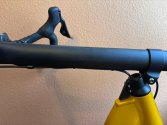
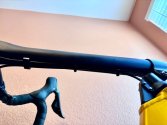
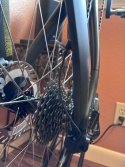
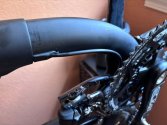
I'll walk you through a few pics, numbered in the order they appear below...

1. I placed the battery inside the end of the boom (not the slider). I had a spare Di2 battery holder, the kind that wedges into a regular seatpost, and that fit perfectly inside the V20c boom, with room above and below for running wires and cables, since the boom and slider are oblong shaped. The battery's wire terminals are pointed toward the handlebar. For a round V20/S40 boom, I imagine I could improvise a battery holder that would work similarly, but since I have not yet been in that situation, I haven't puzzled that one through.

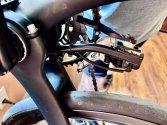
2. This picture is not great. Sorry. There are two bottle cage bolt holes under the slider. I used the one closest to the handlebar to hold the cables. I left the second one open and ran the rear derailleur wire through it and then forward to the fork steerer tube, and down the hole toward the right side of the fork. Back under the slider, this wire disappears between the two brake cable housings, all three managed with a couple of zip-ties. Super clean.

3. The rear derailleur wire comes out of the right fork leg hole and runs to the derailleur. I used rubber housing bumpers to take up any extra room at entry/exit ports, since the wires are slimmer than 4mm and 5mm housing. No wires rattling around.

4 and 5. The front derailleur wire runs internally, through the handlebar, slider, and boom, emerging where a mechanical front derailleur cable would at the bb end of the boom. To give this wire some structure, I gutted a section of brake cable housing and ran the wire through it, creating a tidy loop from the boom to the front derailleur wire port.

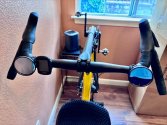
6. This is where things got a little hinky. My aluminum handlebar does not have holes for internal wire routing, so I put them there by drilling small holes just inboard from the shifter hoods and at the center, where the handlebar clamps to the slider, with the hole facing into the slider. This allowed me to run the front derailleur wire and the wire that connects the two shifters to the battery all internally. I thought for a while before doing this, deciding that an good aluminum bar on this kind of bike should be able to handle it. Some people might question me on this move. So far, so good, and my thinking is that if these holes lead to an eventual failure, aluminum will most likely give me ample warning, rather than failing all at once. My money says this will never happen. I wouldn't have done this with a carbon bar, but many carbon bars are ready for internal routing, as are many current aluminum bars. If I ever start to worry about these holes, I can switch to a bar ready for internal routing. Also, if you are using the wireless Di2 setup, you can skip this step. You'll just be running two wires from the battery in the boom to the two derailleurs.
 

Attachments

  • Di2 1.jpeg
    Di2 1.jpeg
    50.3 KB · Views: 7
  • Di2 2.jpeg
    Di2 2.jpeg
    37.6 KB · Views: 5
  • Di 2 3.jpeg
    Di 2 3.jpeg
    53.9 KB · Views: 5
  • Di 2 4.jpeg
    Di 2 4.jpeg
    41.7 KB · Views: 6
  • Di 2 5.jpeg
    Di 2 5.jpeg
    56.2 KB · Views: 7
  • Di 2 6.jpeg
    Di 2 6.jpeg
    58.8 KB · Views: 8

chicorider

Zen MBB Master
I have a possible correction to make on my Di2 install. I had said that I put the battery into the boom with the wire leads facing the handlebars. They might actually be facing the bb. Either way, one of the derailleur wires will have to double-back on itself a little bit. This is not a problem, as long as you have long enough wires. I bought my kit in parts, so none of it came with wires, meaning I could order the specific lengths that I needed. I used string and tape to estimate the various wire runs externally, measured the string, and ordered wire lengths accordingly. No issues there.

Also, if you don't have a tool to run internal wiring and cables, you should get one. It doesn't make the work effortless, but it sure makes it easier. I ordered the one linked below on Amazon for not much, and have used it far more than I thought I would. Definitely worth the small expense. There are several to choose from. The one I chose has been great.


Joe Riel

Active Member
Thanks, very interesting. A silly question, where are the shifters? I have no experience with either electrical shifters or hydraulic brakes. Are mechanical brake levers available with electrical shift levers? Seems like a weird hybrid.
 

Greg S

Guru
Thanks, very interesting. A silly question, where are the shifters? I have no experience with either electrical shifters or hydraulic brakes. Are mechanical brake levers available with electrical shift levers? Seems like a weird hybrid.
Although on the face of it mechanical (cable actuated) brakes with electronic shifting does seem counterintuitive, given how electronic shifting emerged on the scene it’s not so surprising. When Di2 was first introduced there were no “Di2 ready“ frames and disc brake standards were still evolving (post mount, flat mount, axle widths, etc). As you might expect, there were many existing rim brake frames whose owners were interested in electronic shifting for various reasons so there was (and still is) definitely a market.

Likewise with eTap. Being wireless it didn’t have the battery and wire management issues that Di2 had but there were still many more rim brake bikes than those with disc brakes when it was first introduced.

Capitalism abhors a vacuum ;-)

Shifters for either eTap or Di2 with cable actuated brakes are becoming increasingly difficult to find. I suspect that’s one of the reasons Wheeltop e.g., offer a wireless rim brake system.
 

chicorider

Zen MBB Master
Ditto what Greg S said. I run mechanical disc brakes on all but my mountain bike because while I know how to bleed hydraulic brakes, and I have the tools to do the job, I don't like doing it. It's tedious and messy. And since I only weigh 130 pounds, a good set of mechanical disc brakes is more than enough for me. Most electronic groupsets these days only offer hydraulic brakes, but you can still get current-generation Shimano Ultegra and Dura Ace Di2 shifters for rim/mechanical disc brakes. The ST-R9250 for Dura Ace, and the ST-R8150 for Ultegra. I imagine that this option will be phased out when Shimano updates these groupsets.


Top