
Karl42
Well-Known Member
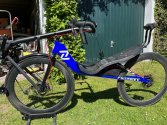
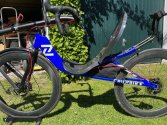
The idea of modifying the V20 so that the seat angle can be adjusted while riding has come up in this forum quite a few times, and some people have actually built some working versions of this. I've been wanting to build my own ever since I saw those other projects, and now I'm finally getting around to do it.
With the unmodified V20, climbing very steep hills in the fully reclined position is much harder than climbing on my upright bike, mainly for two reasons:
1. My power output in the reclined position is lower, perhaps because the heart is at the same height or even lower than the legs.
2. Front wheel traction is suboptimal because the steeper the climb is, the less weight is on the front wheel, and hence, less traction.
While I can get up 20% grade hills on my unmodified V20 if they have a good and clean road surface, I noticed that when I sit upright, both power and traction are much better. However, on the standard V20 I have no back support in the upright position, so I can only sustain that for very short amounts of time by holdying myself up with my arms and my abs. Doing a long Brevet with many climbs will have me climbing in the leaned back position due to exhaustion, and then I have even less power than when sitting upright.
As I prepare for a 600 km ride this summer with 8000 m of climbing, I have a good motivation to finally advance this project and build my own variable seat angle solution for the V20.
The two existing projects that I have studied in depth for inspiration are those:
"The seat of the problem on my new V20" by @Pcmousley: https://forum.cruzbike.com/threads/the-seat-of-the-problem-on-my-new-v20.8182/
Here is his video:
V20 "seat adjustment" by @Salaamaleikum: https://forum.cruzbike.com/threads/seat-adjustment.14231/
Here is his video:
There are various other threads that reference this, for example:
 forum.cruzbike.com
forum.cruzbike.com
forum.cruzbike.com
The thread by Pcmousley is quite old, and it appears that it used to contain images that may have gotten lost when the forum software was upgraded or something like this. So it is only text, and a very short video that is so close-up that it's hard to understand. But after reading his description a few times, I think I fully understand his design.
The other design is by Salaamaleikum. I have been in personal contact with him to ask questions and get CAD files and more pictures, and while his solution is quite clever, it requires custom machined parts and has some aspects that I don't like.
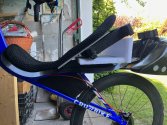
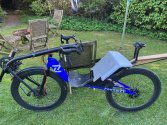
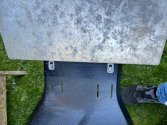
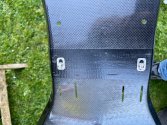
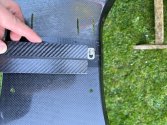
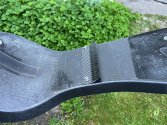
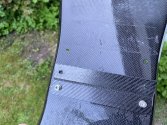
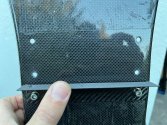
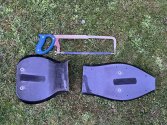
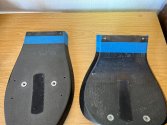
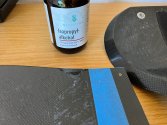
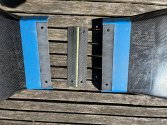
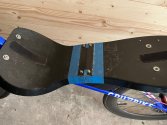
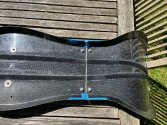
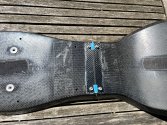
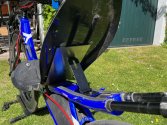
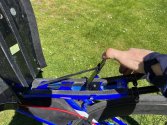
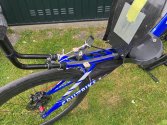
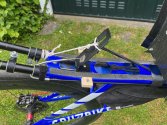
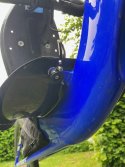
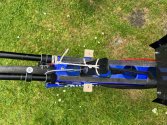
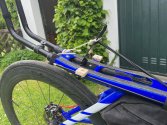
So I'll be mostly copying the design by Pcmousley, with some inspiration from Salaamaleikums work. In particular, I will cut the original V20 seat, join it with a carbon-kevlar hinge, and then support it from behind with a padlock hasp. The mechanism to adjust the seat while riding will follow the design from Pcmously exactly: a bungee cord will pull the hasp towards the front, and a shifter cable will pull it back, operated by a small lever that I will attach under the front end of the seat.
With the unmodified V20, climbing very steep hills in the fully reclined position is much harder than climbing on my upright bike, mainly for two reasons:
1. My power output in the reclined position is lower, perhaps because the heart is at the same height or even lower than the legs.
2. Front wheel traction is suboptimal because the steeper the climb is, the less weight is on the front wheel, and hence, less traction.
While I can get up 20% grade hills on my unmodified V20 if they have a good and clean road surface, I noticed that when I sit upright, both power and traction are much better. However, on the standard V20 I have no back support in the upright position, so I can only sustain that for very short amounts of time by holdying myself up with my arms and my abs. Doing a long Brevet with many climbs will have me climbing in the leaned back position due to exhaustion, and then I have even less power than when sitting upright.
As I prepare for a 600 km ride this summer with 8000 m of climbing, I have a good motivation to finally advance this project and build my own variable seat angle solution for the V20.
The two existing projects that I have studied in depth for inspiration are those:
"The seat of the problem on my new V20" by @Pcmousley: https://forum.cruzbike.com/threads/the-seat-of-the-problem-on-my-new-v20.8182/
Here is his video:
V20 "seat adjustment" by @Salaamaleikum: https://forum.cruzbike.com/threads/seat-adjustment.14231/
Here is his video:
There are various other threads that reference this, for example:
Adjustable seat angle ideas
I got my Thor seat for my V20 in the mail. Since it's the off season I am not in a hurry to mount it, so I have some time to consider a way to make the seat angle adjustable. I just want something that when I am going slower I can sit up and have the advantages of that: little better climbing...
forum.cruzbike.com
Climbing
I did a test run today on one of our local, tough, steep climbs. Bear in mind it was too hot, and my legs are wasted from riding this week with hard efforts yesterday. Climb is short about a mile or a little over, averages 10% with portions 15-20%. I completed 3/4’s of the climb which...
forum.cruzbike.com
The thread by Pcmousley is quite old, and it appears that it used to contain images that may have gotten lost when the forum software was upgraded or something like this. So it is only text, and a very short video that is so close-up that it's hard to understand. But after reading his description a few times, I think I fully understand his design.
The other design is by Salaamaleikum. I have been in personal contact with him to ask questions and get CAD files and more pictures, and while his solution is quite clever, it requires custom machined parts and has some aspects that I don't like.
So I'll be mostly copying the design by Pcmousley, with some inspiration from Salaamaleikums work. In particular, I will cut the original V20 seat, join it with a carbon-kevlar hinge, and then support it from behind with a padlock hasp. The mechanism to adjust the seat while riding will follow the design from Pcmously exactly: a bungee cord will pull the hasp towards the front, and a shifter cable will pull it back, operated by a small lever that I will attach under the front end of the seat.
Last edited: