
Robert Volk
Member
1st Overall and Course Record on My Cruzbike
210 miles · 8,000+ ft climbing · 13:03 · 1st Overall AND Course Record!
NCOM Roll Call and Stats:
https://docs.google.com/spreadsheet...AberMOOw3RyOl02tMvjl5PAjDWwXIBtVkasrO/pubhtml
What a fantastic day racing NCOM on my Cruzbike!
After 210 miles and more than 8,000 feet of climbing, I finished 1st overall in 13 hours and 3 minutes, 19 minutes ahead of the first-place rider on a traditional diamond-frame (DF) bike.
It was a long day of climbs, fast descents, and some great back-and-forth racing with Dave Kaiser. I was pleased with how my training prepared my legs for the distance. My stomach, however, had other ideas during the final 50 miles.

After 210 miles and more than 8,000 feet of climbing, a first-place finish.
My Race Strategy: Power Targets by Mileage
For this race, I tried something I hadn't done before: I created a power-based workout for my Garmin Edge, with targets set by mileage and the terrain ahead.
The idea was to be deliberate about where I spent my energy. On long, gradual descents, I lowered the power target. Why burn an extra 30 watts to gain only two or three miles per hour? On flat roads and gradual inclines, I generally aimed for the middle of Zone 2. My goal was to keep most of my riding at approximately 185 watts or less, although some of the steeper climbs made that impossible.
Early in the race, one extended, gently descending section had a particularly low power target. My legs felt great, and I remember wondering whether I was taking it too easy. It felt as though I was barely doing any work! But that was the point: the terrain didn't demand more, and there was a lot of racing still to come.
Overall, the approach worked well. I was able to follow the pacing plan for most of the race. During roughly the final 30%, my legs began to feel more tired, and I was sometimes below the power I wanted to produce. Still, I was generally not far off the targets.
I'll use this terrain-based approach again. Having the appropriate power target appear at the right point on the course was a helpful reminder not to spend energy just because I felt good in the moment.
A Little Racing Action with Dave Kaiser

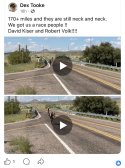
Still neck and neck after more than 170 miles.
Dave Kaiser and I spent much of the day trading places between first and second. That made for some really fun racing! Having another rider out there to compete with makes a long event a lot more interesting.
One of the highlights came on a fast descent, when I passed Dave at around 50 mph. What a blast! It was a fun road to descend, and I only needed to tap the brakes a couple of times on corners where I couldn't see far enough around the bend.
I don't think there was a single dramatic moment that decided our race. After that descent, the course was generally easier than the preceding uphill and rolling sections. I was in front, and knowing that gave me a little extra motivation to keep going.
Eventually, I didn't see Dave again during the final 30-some miles.
Five Big Climbs and Some Great Descents

The kind of terrain that made pacing by mileage so useful.
The course had five major climbs. To me, the third was the hardest, followed by the fourth. By then, the climbing was starting to catch up with my legs, so even though the fifth climb wasn't as difficult as those two, it certainly felt difficult.
The descents were a different story. There were some really fun ones, including two particularly big descents, and the one where I passed Dave was easily the most memorable.
The weather also worked out well. The forecast called for a low of 62°F and a high of 79°F, which sounded just about perfect to me, being from Minnesota. My bike computer recorded a much wider range—44°F to 99°F, with an average of 79°F—but overall, I thought the temperatures were great for racing.
The Last 50 Miles: My Stomach Was the Problem
The final 50 miles were rough, but not primarily because of my legs. My gut felt terrible. I was very queasy, and unfortunately, this wasn't the first time I'd dealt with that feeling during an ultra-distance ride.
I kept going, knowing I was getting closer to the finish, whether my stomach felt good or not.
At one point, a vehicle with NCOM stickers passed me. I thought it was Dave's follow vehicle leapfrogging ahead, which made me worry that he was catching up. I picked up my pace and rode at high Zone 2 to low Zone 3 power for several minutes.
Then I looked at my heart rate. It was climbing too high for the distance I still had left, so I backed the effort down. It turned out the vehicle wasn't Dave's follow vehicle at all—it was DX in the SAG vehicle, keeping an eye on things.
That's one of the challenges of racing this distance. Even when you're competing for the lead, you have to keep making decisions based on how much road is left.
Nutrition and Hydration: What Worked and What Didn't
For electrolytes, I used LMNT, splitting one packet across three bottles. That worked out to approximately 333 mg of sodium per bottle.
For nutrition, I used UCAN for roughly the first six hours. Around 11 a.m., I also had a bratwurst for lunch.
By about mile 118, my stomach was beginning to feel queasy. I stopped using UCAN and switched from water to Sprite. The carbonation felt good, and I felt that the sugar gave me a noticeable boost of energy.
Unfortunately, the stomach trouble remained a major part of the latter stages of the race. My legs still felt capable of doing what I asked of them, but my gut made those last miles much less pleasant than they could have been.
This is probably the biggest thing I want to improve before my next long event: developing and practicing a better nutrition and hydration plan, including on longer training rides.
Racing a Cruzbike: The “Picasso Bike”

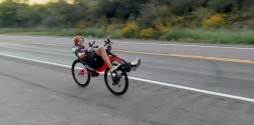
The Cruzbike definitely attracts attention.
One of the entertaining parts of racing a Cruzbike is seeing the reactions of people who have never encountered one before.
At the beginning of the race, the person handing out GPS trackers took one look at my bike and said, “Oh, you have a Picasso bike!”
I laughed and replied, “Yeah, it's a Cruzbike!”
Actually, I thought that was a pretty good description. To someone unfamiliar with its design, it really does look like a piece of modern art on wheels!
After the race, plenty of people had questions. The one I hear most often is, “How does that thing climb hills?”
I enjoy those conversations because they give me a chance to explain what makes the Cruzbike such a unique machine. What looks unconventional at first is an intentional engineering design. I appreciate its aerodynamic riding position, comfort over long distances, and speed on descents. And despite what some people assume about recumbents, it climbs remarkably well, too!
My setup features SRAM AXS wireless shifting, hydraulic disc brakes, and deep-section tubeless HED wheels. For me, it's become my dream endurance racing machine.
Another fun part of the day was passing through the small towns along the route. Adults and kids would point, smile, and wave as I rode by. You definitely don't blend into the crowd on a Cruzbike!
The Finish: Welcome to Alpine!
Toward the end, I finally saw the Welcome to Alpine sign, and my reaction was pretty simple: Yay! Finished!
I was especially pleased that I was still in first place when I reached the neutral zone on the outskirts of town.
After such a long day—and especially after struggling with my stomach for so many miles—it was a great feeling to reach that point knowing I'd held the lead.
What I'd Keep—and What I'd Change
I felt that my training this year worked really well for this race. My legs never reached a point where they simply couldn't do what I asked of them. That was encouraging, especially with five big climbs and so many hours on the bike.
If I raced NCOM again, there are two things I'd change. First, I'd probably include more threshold training to prepare for the climbing. Second, I'd develop a different or improved nutrition and hydration strategy and practice it on longer rides. The stomach issues were clearly a bigger limitation than my legs.
I'd also keep the mileage-based Garmin power plan. It was my first time trying that approach, and I found it genuinely helpful—especially early on, when fresh legs made it tempting to ride harder than the terrain required.
All in all, NCOM was an excellent day of racing. I loved the competition with Dave, the climbs, the fast descents, and the chance to show what a Cruzbike can do on a demanding endurance course.
Fast, comfortable, efficient—and just plain fun!
If you're a Cruzbike rider considering NCOM, I'd definitely encourage you to give it a try.
Ride on Strava: View my NCOM ride
Race video: Watch the downhill descent and pass
Attachments
Last edited: