

RojoRacing
Donut Powered Wise-guy
This one is for the 1% of you who are both willing to pull out your internal shifting cable and or brake hose from the steering tube, and will ever ride in the rain or hose down your bike to clean it. For everyone else riding in dry weather with only the occasional wipe down, you'll probably be fine for years. When I built the V20c I couldn't help but notice the complete lack of dust or water seals keeping the headset bearing clean and dry. Since I'm going through all the trouble of installing a Crane Creek viscoset, I figured I'd do something to keep that friction stack as clean as possible for longer service intervals. If you do want to give this a shot, it'll cost you about $17 in gaskets and O-rings and a new brake hose end because you have to cut off the existing one to remove it from the fork to install these seals. You don't need to install a Viscoset to benefit from the mod, it'll protect your stock bearings all the same. If you are going through the trouble of installing a viscoset like @Greg S is , you may as well do this all well since you already have to take everything apart.
Link to the parts used
2x59x63mm
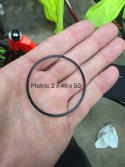
2x46x50mm
1.5"
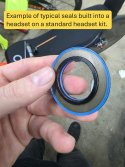
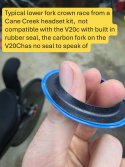
For example, here are the built-in seals on a typical bike headset kit, the V20c stock has none of these.
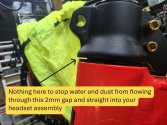
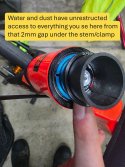
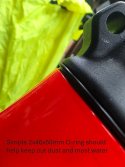
Here's the open gap I'm concerned with.
If you want to do the bare minimum and avoid the risk of extra friction from, using the large silicone gasket in the next step, then all you need is a single 2mm O-ring. This should be 99% effective and cause zero added fiction. I'll be doing the same to the gap on the lower race as well, with no additional internal gasket because I can't find one that would fit.
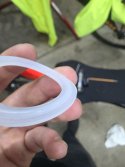
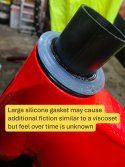
If you want to go the extra mile and experiment alongside me, you can also install this silicone gasket in addition to the external O-rings. The gasket is one piece, but made up of one a large middle flat flange, and a raised O-ring style protusion on each side. You'll need to trim off the O-ring from the side you face up with some flush cut pliers, because otherwise it's too thick and causes noticeable friction in the steering. With one side trimmed flush and greased all surfaces to let it glide during turning, and with the viscoset already installed, I don't feel any additional friction.
Link to the parts used
2x59x63mm
2x46x50mm
uxcell Nitrile Rubber O-Rings 50mm OD 46mm ID 2mm Width, Metric Sealing Gasket for Automotive Machine Plumbing, Pack of 5: Amazon.com: Industrial & Scientific
uxcell Nitrile Rubber O-Rings 50mm OD 46mm ID 2mm Width, Metric Sealing Gasket for Automotive Machine Plumbing, Pack of 5: Amazon.com: Industrial & Scientific
www.amazon.com
For example, here are the built-in seals on a typical bike headset kit, the V20c stock has none of these.
Here's the open gap I'm concerned with.
If you want to do the bare minimum and avoid the risk of extra friction from, using the large silicone gasket in the next step, then all you need is a single 2mm O-ring. This should be 99% effective and cause zero added fiction. I'll be doing the same to the gap on the lower race as well, with no additional internal gasket because I can't find one that would fit.
If you want to go the extra mile and experiment alongside me, you can also install this silicone gasket in addition to the external O-rings. The gasket is one piece, but made up of one a large middle flat flange, and a raised O-ring style protusion on each side. You'll need to trim off the O-ring from the side you face up with some flush cut pliers, because otherwise it's too thick and causes noticeable friction in the steering. With one side trimmed flush and greased all surfaces to let it glide during turning, and with the viscoset already installed, I don't feel any additional friction.